
Thank you! We'll be in touch shortly with your free pool deck estimate.
POOL DECK PAVERS — BREVARD COUNTY, FL
Pool Deck Pavers | Pavers Commandos Melbourne
Florida's intense UV exposure, thermal cycling, and poolside moisture demand more than plain concrete. We install travertine, concrete, and porcelain pool deck pavers engineered for slip-resistance, heat dissipation, and chlorine-resistance — built to perform for decades in Brevard County's subtropical climate.
THE INSTALLATION PROCESS
Engineered Pool Deck Installation — From Subbase to Surface
Every Pavers Commandos Melbourne pool deck project begins with precision subgrade preparation. Our crews excavate to a minimum 6-inch compacted base layer — typically a crushed-limerock or compacted aggregate sub-base — to prevent the lateral shifting endemic to Brevard County's silica-sand and organic-fill soils. Proper compaction is verified to a Proctor density standard before any bedding sand is placed, ensuring long-term structural stability under the thermal loading unique to Florida pool environments. A minimum 1/4-inch-per-foot slope away from the pool coping is engineered into every installation to direct poolside runoff cleanly to perimeter drains and prevent moisture infiltration beneath the paver field.
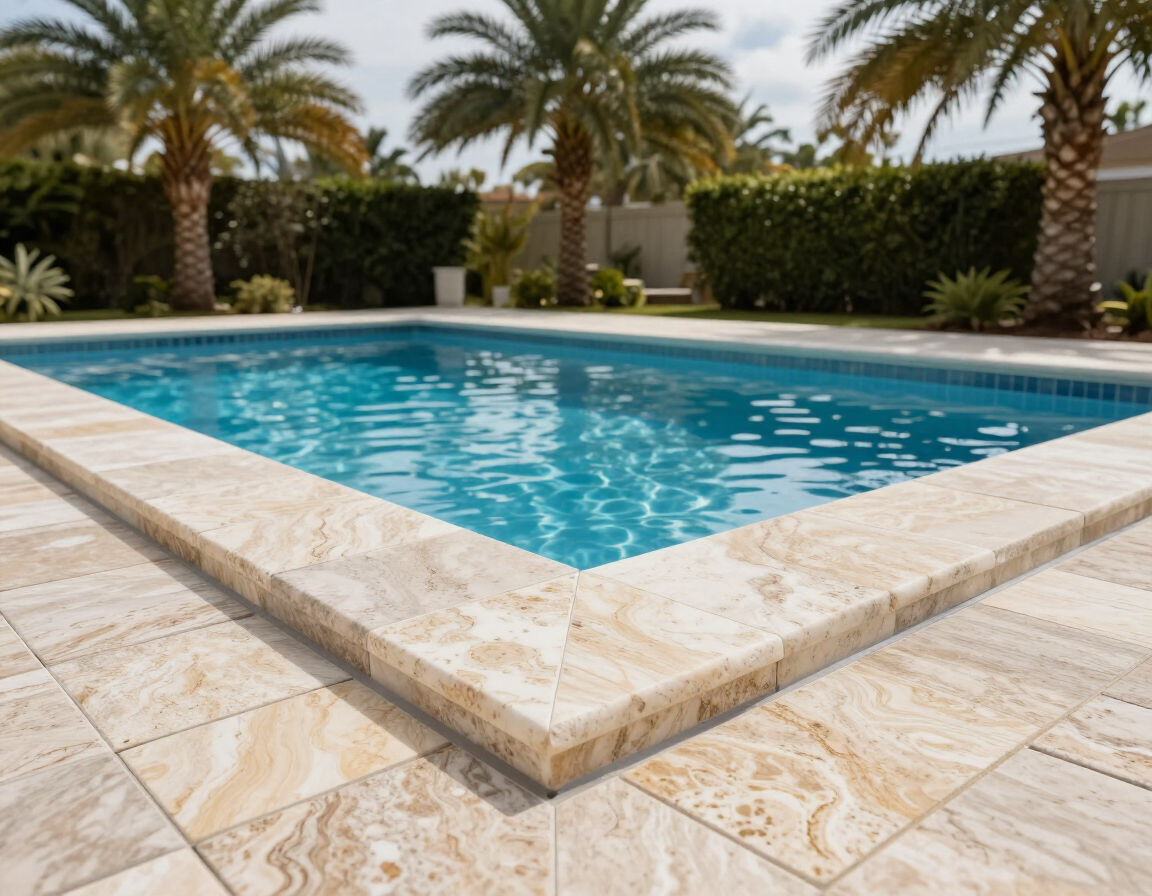
Coping integration is one of the most technically demanding phases of pool deck paver installation. Our crews set coping pavers — typically travertine or tumbled concrete — flush with the pool bond beam using polymer-modified mortar rated for continuous wet exposure and chlorine splash. Expansion joints are placed at intervals no greater than 10 to 12 linear feet, as well as at every perimeter coping transition and structural change point. Florida's diurnal temperature swings — surface temperatures on an unshaded pool deck can shift more than 60°F between midnight and mid-afternoon — generate significant thermal cycling stress in any rigid surface system. Correctly specified expansion joints filled with ASTM C920 sealant prevent joint heaving, paver pop-up, and structural cracking that plague improperly installed pool decks across the Space Coast.
For the paver field itself, we offer three primary material systems: natural travertine, architectural-grade concrete pavers, and full-body porcelain tile pavers. Travertine remains the benchmark for solar reflectance and barefoot comfort — its naturally porous calcium carbonate microstructure dissipates surface heat faster than dense concrete and maintains a surface temperature 15–20°F cooler underfoot than comparably colored plain concrete slabs under direct Florida sun. Concrete pavers offer maximum customization of thickness (standard 2-3/8 inch or heavy-duty 3-1/8 inch for high-traffic commercial pool decks) and come factory-sealed with UV-stable integral pigments that resist Florida's Class 5 UV index. Porcelain pavers offer near-zero water absorption (≤0.1% per ASTM C373), making them fully impervious to chlorine, salt water, and pool chemical splash — the optimal choice for saltwater pool systems common throughout Brevard County.
TECHNICAL SPECIFICATIONS
Pool Deck Paver Material Comparison — Brevard County Standards
The table below details the four primary performance dimensions Pavers Commandos Melbourne evaluates when specifying pool deck materials for Florida residential and commercial projects. All surface temperature ratings were measured under ASHRAE standard outdoor test conditions at peak Florida summer solar load.
| Material Type | Surface Temp Rating (Peak Sun) | Slip-Resistance Coefficient (DCOF) | Average Lifespan | Chlorine / Chemical Resistance |
|---|---|---|---|---|
| Natural Travertine | ~115–125°F (excellent solar reflectance, 15–20°F cooler than concrete) | ≥ 0.42 DCOF wet (ADA compliant) | 25–35+ years sealed | High — calcium carbonate resists pool pH 7.2–7.6; requires annual sealing against acid wash exposure |
| Architectural Concrete Pavers (2-3/8") | ~130–145°F (color-dependent; lighter integral pigments reduce thermal gain) | ≥ 0.60 DCOF textured surface | 20–30 years with polymer sealer | Moderate-High — resists standard chlorine; joint sand requires polymeric stabilization |
| Heavy-Duty Concrete Pavers (3-1/8") | ~130–145°F | ≥ 0.60 DCOF | 30–40 years (commercial loading rated) | Moderate-High — same as standard concrete paver; thicker section improves resistance to freeze-thaw (not a Florida factor) but adds structural depth |
| Full-Body Porcelain Pavers | ~135–150°F (dense body retains more heat than travertine) | ≥ 0.42–0.60 DCOF depending on surface finish | 30–50 years | Excellent — water absorption ≤ 0.1% per ASTM C373; impervious to chlorine, salt, and pool chemicals |
All materials installed by Pavers Commandos Melbourne are sourced to meet or exceed Florida Building Code Section 1807 requirements for exterior flatwork. Expansion joint placement, bedding sand specification, and polymeric jointing sand are selected per project-specific thermal and moisture load analysis.
WHY POOL DECK PAVERS
Built for Barefoot Comfort, Built for Florida Durability
Choosing interlocking pavers over a poured concrete slab for your pool deck is one of the highest-value structural decisions a Brevard County homeowner can make. Here is why property owners from Melbourne to Sebastian consistently select paver systems for pool surround applications:
- Natural Coolness Underfoot — Travertine and light-toned concrete pavers reflect solar radiation more efficiently than monolithic concrete slabs, reducing peak surface temperatures by up to 20°F on a mid-summer Brevard County afternoon.
- Easy Damaged-Unit Replacement — Individual pavers can be lifted and replaced without saw-cutting, grinding, or color-matching an entire slab — a critical advantage when pool chemical spills, tree root intrusion, or point-load damage occur over the system's lifespan.
- UV-Stable Color Options — Factory-installed integral pigments and UV-resistant sealers prevent the chalky bleaching and surface carbonation common in unsealed concrete under Florida's Class 5 UV index, maintaining curb appeal for 15–25 years between major maintenance cycles.
- ADA-Compliant Surface Textures — All paver products specified by Pavers Commandos Melbourne meet ANSI A137.1 wet DCOF ≥ 0.42 slip-resistance thresholds, satisfying ADA surface safety requirements for publicly accessible pool surrounds and commercial aquatic facilities.
- Chlorine and Salt-Water Resistance — Properly sealed travertine and porcelain pavers resist the pH and chemical loads of both traditional chlorine and salt-chlorination pool systems, preventing the spalling and surface erosion that compromises plain concrete pool decks within 5–10 years of installation in high-use Florida environments.
- Thermal Expansion Compatibility — Interlocking paver systems accommodate Florida's diurnal thermal cycling through natural joint movement rather than transferring stress to a monolithic slab, virtually eliminating the mid-slab cracking that typically appears within 3–5 years in standard poured concrete pool decks across Brevard County.
SERVICE AREA SPOTLIGHT
Pool Deck Paver Projects Across Brevard County
Our pool deck paver installations in Melbourne, FL span everything from compact residential pool surrounds in established neighborhoods near Eau Gallie to large resort-style aquatic hardscapes on the barrier island. Melbourne homeowners consistently cite thermal comfort, slip-resistance, and the ability to replace individual units without demolition as the primary drivers for upgrading from aging concrete slabs to interlocking paver systems. Explore our full range of services available to Melbourne-area property owners on our Melbourne service area page .
In Sebastian, FL, our crews have completed pool deck paver projects ranging from single-family residential upgrades near the Sebastian Inlet corridor to elevated outdoor living spaces on larger acreage properties in Indian River County. Sebastian's deep sandy soils require careful subbase specification — typically a 6-inch compacted crusher-run base with a geotextile fabric separator — to prevent differential settling under pool deck loading. Learn more about our pavers work serving the Sebastian community on our Sebastian service area page .
SERVICE COVERAGE MAP
Pool Deck Paver Installations Across Brevard County, FL
Pavers Commandos Melbourne services residential and commercial pool deck paver projects throughout Brevard County and the surrounding Space Coast region — from Rockledge and Cocoa in the north to Sebastian and Vero Beach to the south. Our centrally located Melbourne operations center allows rapid mobilization across the county for site assessments, material delivery, and full installation crews.
FREQUENTLY ASKED QUESTIONS
Pool Deck Paver FAQs — Florida Climate & Installation
Choosing the right pool deck surface in Florida's subtropical environment involves more technical decisions than most homeowners expect. The four questions below address the concerns we hear most often from Brevard County pool deck clients.
How do I prevent UV fading and color degradation on my pool deck pavers?
Florida's sustained Class 4–5 UV index is the primary cause of surface color degradation in outdoor hardscape materials. For concrete pavers, Pavers Commandos Melbourne specifies factory-integral pigments rather than surface-applied colorants — integral color penetrates the full paver body so UV erosion of the surface millimeters does not alter overall color appearance. We apply a UV-stable acrylic or polyurethane penetrating sealer immediately after installation and recommend a full re-seal every 2–3 years for concrete pavers under Florida solar exposure. Travertine, being a natural stone, experiences minimal color shift under UV; however, a penetrating silane-siloxane sealer is critical to prevent chlorine and mineral staining from poolside splashing. Porcelain pavers require no sealing and carry full-body color that is inherently UV-stable for the product's full service life.
What sealing is required for pool deck pavers, and how often?
Sealing requirements differ by material system. Concrete pavers should receive a penetrating acrylic or polyurethane sealer at installation and be resealed every 2–3 years depending on pool chemical exposure and sun intensity — the salt and chlorine chemistry of poolside environments accelerates sealer breakdown compared to standard driveway or patio applications. Natural travertine requires a silane-siloxane penetrating sealer at installation to fill its natural pore structure, preventing chlorine and tannin staining; resealing every 1–2 years is recommended for travertine in active poolside environments. Porcelain pavers do not require sealing due to their ≤0.1% water absorption — however, the polymeric jointing sand between porcelain units should be inspected and refreshed every 3–5 years as UV and water flow can gradually wash fine particles from joints over time.
What surface textures are safest for barefoot pool deck use?
Barefoot slip resistance is governed by the Dynamic Coefficient of Friction (DCOF) measured in wet conditions per ANSI A137.1 standards. A minimum DCOF of 0.42 wet is the ADA threshold for exterior wet surfaces, but for pool decks — where surfaces are continuously wet and occupants are unshod — we recommend specifying materials with a DCOF of 0.50 or higher. Natural travertine in a tumbled or brushed finish consistently achieves DCOF ≥ 0.50 due to its irregular micro-surface texture. Concrete pavers with an exposed-aggregate or shot-blast finish provide DCOF in the 0.55–0.70 range. We specifically avoid specifying high-polished porcelain or honed marble finishes for pool deck applications, as wet DCOF on polished stone can fall below the 0.42 ADA threshold — a significant safety and liability concern for residential and especially commercial pool operators.
How far apart should expansion joints be placed on a Florida pool deck?
Expansion joint spacing is one of the most critical and most frequently misspecified variables in Florida pool deck installations. Florida's subtropical climate generates surface temperature swings from roughly 65°F at winter night minimum to over 145°F at midsummer peak solar load — a 80°F thermal range that generates significant expansion and contraction stress in any paver or mortar-set material. Pavers Commandos Melbourne places soft expansion joints — ASTM C920 polyurethane or silicone sealant — at a maximum interval of 10–12 linear feet in all directions across the paver field, at every change of plane (steps, grade transitions, coping-to-deck junctions), and at all structural boundaries including pool bond beams, planter walls, and building foundations. This spacing is tighter than many national guidelines, and deliberately so — Brevard County's lack of freeze-thaw cycles means all thermal movement is one-directional (expansion under heat) rather than cyclic, creating sustained directional stress that wider joint spacing cannot adequately relieve.
GET YOUR FREE ESTIMATE
Ready to Upgrade Your Pool Deck? Let's Talk.
Whether you are replacing a cracked, slippery concrete pool deck in Melbourne or designing a new travertine-clad aquatic hardscape in Sebastian, Pavers Commandos Melbourne provides a no-cost, no-obligation site assessment and written estimate. Our team evaluates your existing subbase conditions, pool geometry, drainage slope requirements, and material preferences to deliver a precise scope and specification — not a ballpark number. Contact us today to schedule your free pool deck paver consultation.